Want to know how to check purity of ghee before you use it in your family’s food? Ghee is one of the most adulterated foods in India. Loose and very cheap ghee is often mixed with vanaspati (hydrogenated vegetable oil), refined oils, animal fat or even starch to cut costs. The good news is that you can spot most of these with simple tests in your own kitchen. Here are seven easy ways to check whether your desi ghee is pure.
Why Ghee Purity Matters
Pure desi ghee is made only from milk fat. Adulterated ghee may look similar, but it can contain trans fats from vanaspati, cheap oils or other fats that you never chose to eat. It also simply does not taste or smell like real ghee. Checking purity protects your health, your money and the taste of your food.
7 Simple Tests to Check Ghee Purity at Home
1. The Heat Test (Easiest)
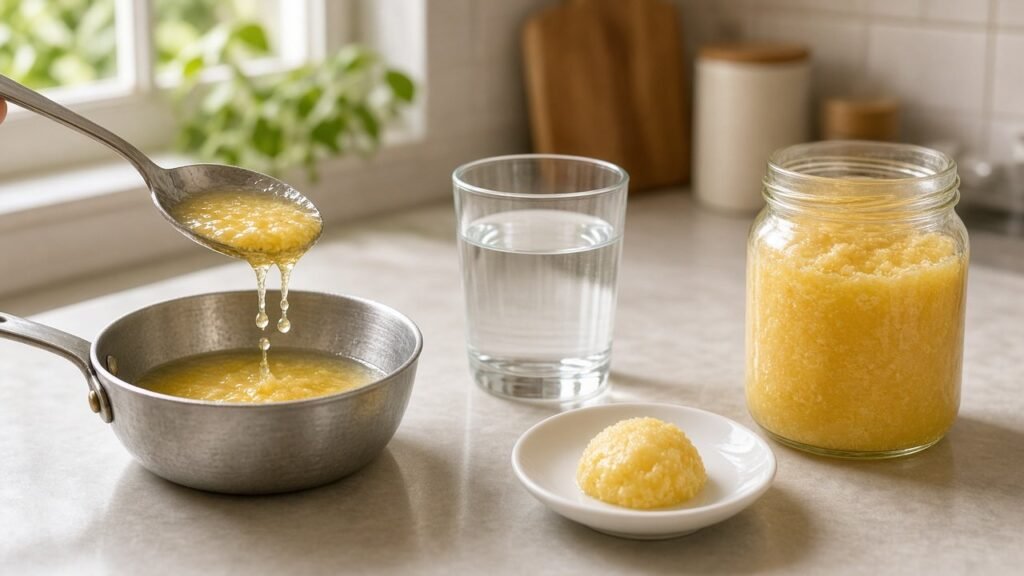
Put one teaspoon of ghee in a small pan and heat it on a low flame.
- Pure ghee melts quickly into a clear, golden-brown liquid and gives off a rich, nutty aroma.
- Adulterated ghee takes longer to melt, may leave a yellowish residue or foam, and can smell like oil.
2. The Palm Test
Place a small amount of ghee on your palm. Pure ghee starts melting within a few seconds at body temperature. If it stays solid for a long time or feels greasy and waxy, it may contain vanaspati or other fats with a higher melting point.
3. The Double Boiler (Fridge) Test
Melt a little ghee in a glass jar by placing the jar in a bowl of hot water. Then put the jar in the fridge for an hour or two.
- Pure ghee sets evenly as one layer.
- If you see separate layers, the ghee may be mixed with coconut oil or other oils, which set at different temperatures.
4. The Iodine Test (for Starch)
Some sellers add boiled potato, sweet potato or other starches to increase weight. Melt half a teaspoon of ghee, let it cool slightly and add two or three drops of iodine solution (available at chemists).
- No colour change: no starch.
- The mixture turns blue or purple: starch is present.
5. The Sugar and Hydrochloric Acid Test (for Vanaspati)
This is a well-known test for vanaspati. Mix one teaspoon of melted ghee with an equal amount of concentrated hydrochloric acid in a test tube and add a pinch of sugar. Shake and leave for five minutes. A crimson or pink-red colour in the lower layer suggests vanaspati or certain added oils. Hydrochloric acid is corrosive, so this test should only be done by an adult with gloves, or at a testing lab.
6. The Smell and Taste Test
Real desi ghee has a warm, nutty, slightly sweet aroma, and bilona ghee has a distinct “ghar ka ghee” smell. Rub a little between your fingers and smell it. If it smells like oil, smells rancid or has almost no smell, be careful. On the tongue, pure ghee melts smoothly and leaves a pleasant aftertaste, not a waxy coating.
7. The Texture and Colour Check
At room temperature, traditional desi ghee (especially bilona ghee) usually sets with a grainy, danedar texture. Pure cow ghee is golden yellow and pure buffalo ghee is white. An unnatural bright yellow colour in buffalo ghee, or a very pale colour in cow ghee, may mean added colour or mixing. Read more in our guide on cow ghee vs buffalo ghee.
Is the Water Test Reliable?
You may have heard that pure ghee floats in water and adulterated ghee sinks. In reality most fats and oils float on water, so this test cannot reliably detect vanaspati or oil. Use it only as a rough check alongside the tests above.
Common Adulterants in Ghee
| Adulterant | Why it is added | Best home test |
|---|---|---|
| Vanaspati (hydrogenated oil) | Cheap and looks like ghee | Heat test, palm test, sugar and HCl test |
| Refined vegetable oils | Lowers cost | Fridge test, smell test |
| Coconut oil | Lowers cost | Fridge test (separate layers) |
| Starch (potato, sweet potato) | Adds weight | Iodine test |
| Artificial colour | Makes cheap ghee look golden | Colour check, heat test |
Lab Testing and FSSAI
Home tests are helpful, but they cannot catch everything. Laboratories check ghee using parameters such as the BR reading and RM value, which show whether the fat is genuine milk fat. The Food Safety and Standards Authority of India (FSSAI) also publishes simple guides for detecting common food adulterants at home. When buying packed ghee, always check for an FSSAI licence number, a manufacturing date and a clear address of the maker.
Tips to Buy Pure Ghee
- Know the maker. Buy from a brand or dairy that tells you exactly how its ghee is made.
- Be wary of very cheap ghee. Real desi ghee needs a lot of milk. A price far below the market rate is a warning sign.
- Prefer small-batch, traditionally made ghee. Small batches are easier to control and stay fresher.
- Check the label for FSSAI number, ingredients (“milk fat” only) and dates.
- Test a small pack first. Try a 500g pack before buying a large tin.
Nanak Ghee: Pure Bilona Desi Ghee from Mohali
At Nanak Ghee we make bilona desi cow ghee, A2 desi cow ghee and bilona-churned desi buffalo ghee from milk only: set into curd, churned into makkhan and slow-cooked in small batches in Sohana, Mohali. No vanaspati, no oil, no colour and no preservatives. Try any of the tests above on our ghee. We are confident it will pass.
Shop pure desi ghee online, with home delivery in Mohali, Chandigarh, Zirakpur, Kharar and Panchkula and shipping across India. Have a question? See our FAQs or WhatsApp us on 97819 83883.
Frequently Asked Questions
How can I check if ghee is pure at home?
The easiest way is the heat test: warm a teaspoon of ghee in a pan. Pure ghee melts quickly into a clear golden liquid with a rich aroma. You can also try the palm test, the fridge test and the iodine test for starch.
How do I know if ghee has vanaspati in it?
Ghee mixed with vanaspati melts slowly, feels waxy on the palm and smells less like ghee. The sugar and hydrochloric acid test turns crimson red if vanaspati is present, but it should be done carefully by an adult or at a lab.
Does pure ghee float on water?
Yes, but so do most oils and fats, so the water test is not a reliable way to check ghee purity on its own.
Why is my ghee grainy?
A grainy or danedar texture is normal and is a sign of traditionally made ghee, especially bilona ghee that cools slowly after cooking.
What colour should pure ghee be?
Pure cow ghee is golden yellow, while pure buffalo ghee is white or creamy white. Both are natural colours.
Does pure ghee need to be refrigerated?
No. Pure ghee keeps well at room temperature in a clean, dry, airtight container. Always use a dry spoon to avoid moisture.